Technology
It understands first, then it moves.
BroBot's AI is layered. One layer understands speech, intent and context; a faster layer perceives and moves; at the bottom a safety layer checks every command. Motion decisions are made inside the robot, at the edge.
- Voice
- Cameras
- 360° LiDAR
- IMU · odometry
- Bumper
- System 2Understands and decidesLanguage · intent · task
- System 1Perceives and movesPosition · obstacles · path
- System 0Reflex and safety100 commands a second · watchdog · e-stop
- Speech
- Screens
- Motors
All inside the robot · NVIDIA Jetson AGX Orin
Each layer at its own speed.
Understanding takes time; motion cannot wait. So BroBot's decisions are split into three layers: each runs at its own speed and hands the goal of the layer above down to the one below.
System 2Thinks slow
Understands and decides.
- Understands natural spoken Turkish and the intent: “Take me to the meeting room.”
- Recognises staff who opted in, by name and title.
- Orders the task: notify the host, plan the route, take the elevator when needed.
- Uses the places, people and knowledge the organisation keeps in BroBot Studio.
System 1Thinks fast
Perceives and moves.
- Finds its position on the building's map.
- Sees obstacles with its 360° LiDAR and depth camera, thin tapes and belts included.
- Replans its path all the time; leads at a walking pace and waits for the visitor.
- Rides the elevator, passes doors, docks at its charging station.
System 0100 commands a second
Reflex and safety.
- Our own motor-control firmware drives the motors with 100 commands a second.
- If the command stream stops, a watchdog stops the motors.
- An independent collision monitor checks the final motion command.
- It stops at once on bumper contact and on the hardware emergency stop.
“Take me to the meeting room.”
The path one sentence takes inside the robot: System 2 understands what is asked, System 1 keeps working out how to get there, System 0 checks every motion.
- S2
Heard: “Take me to the meeting room.”
- S2
Goal: meeting room · floor 2
- S2
Notify the host: phone call
- S1
Route: lobby → elevator → floor 2 → meeting room
- S1
Someone crosses ahead: slow down, wait, go on
- S1
Elevator: call, board, turn, exit
- S0
Every motion command checked
- S2
Arrived: meeting room; the host knows
The robot's senses.
Every sensor reading is processed inside the robot. Edge AI runs on NVIDIA Jetson AGX Orin; face recognition runs on the robot's own GPU.
Edge AI: perception, localisation and face recognition run inside the robot.
- 01
360° LiDAR
Scans its surroundings up to 25 metres; 0.36 m above the floor.
- 02
Depth camera
Looks forward and 30° up.
- 03
Face camera
Recognises staff who opted in; recognition happens inside the robot.
- 04
Four microphones
Find the direction of a voice and cancel echo.
- 05
IMU and wheel odometry
Measure its motion and turning.
- 06
Front bumper
Stops the robot on contact.
When in doubt, it stops.
Safety is not left to a single sensor; it is layered. When a sensor or the position cannot be trusted, fail-closed guards stop the motion.
- L1
Independent collision monitor
A layer independent of the planner checks the final motion command.
- L2
Fail-closed guards
Lost localisation, depth-camera health, sensor input watchdogs: not trusted, not moving.
- L3
Low obstacles
Thin barrier tapes and belts.
- L4
Front bumper
A three-section contact switch; the motor firmware stops on contact.
- L5
Hardware emergency stop
Cuts motor power in hardware.
What happens when
- Position not trusted
- Stops; does not move until the position is trusted again.
- Depth camera not responding
- Stops; continues when the camera recovers.
- Command stream stops
- The motor watchdog stops the motors.
- Bumper contact
- The motor firmware stops at once.
Decisions on the robot, the fleet in the cloud.
BroBot makes its own decisions; the cloud manages, updates and backs up the fleet. Live since 20 October 2026.
- 01
On the robot
Decisions are made here: perception, position, motion and safety. The robot's internal network never leaves it.
- 02
In the cloud
Fleet management, over-the-air updates, nightly encrypted backups and simulation testing on AWS. It talks to the robot only through an encrypted link.
- 03
On your screen
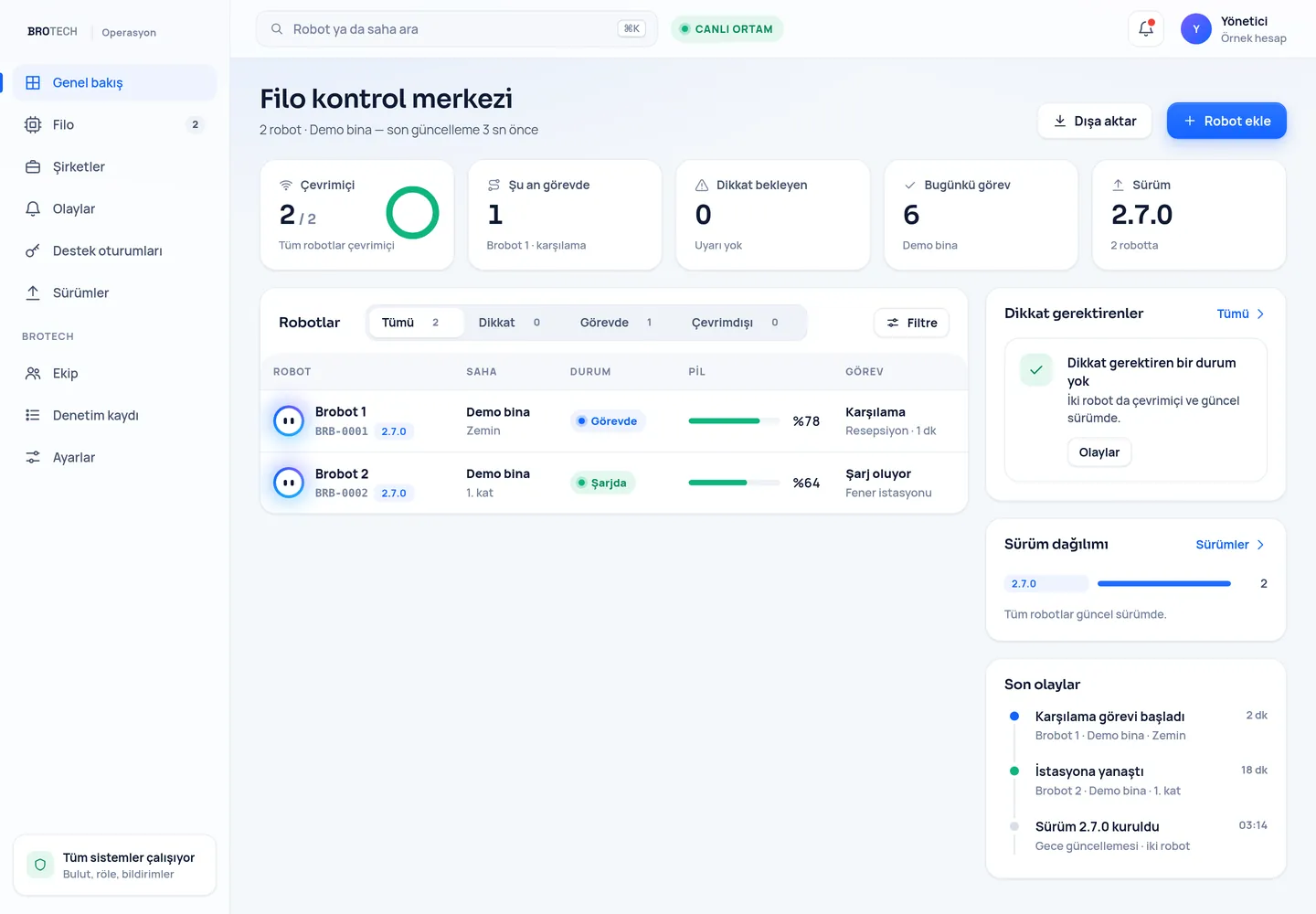
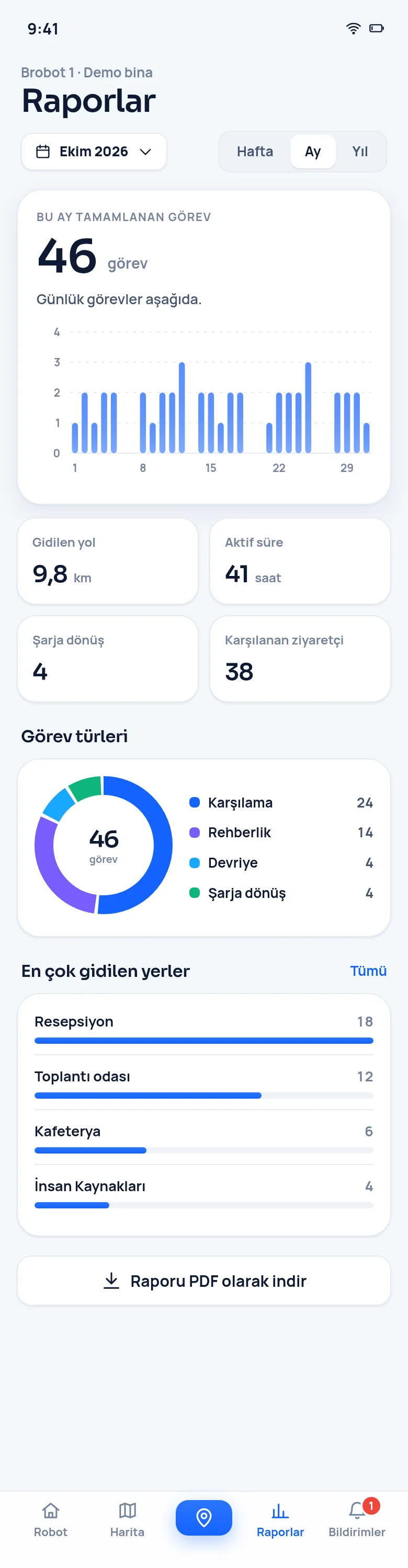
Customer portal: dashboards, monthly report, notifications, remote tasks. Manufacturer console: fleet and support for the BROTECH team.
Every change, before it reaches a robot.
Thousands of automated tests and simulations that run in the cloud every night: people crossing, narrow doors, tapes, elevators, docking, sensor failures. A release that passes is installed over the air and can be rolled back.
- ~2,550
- automated tests in the kiosk and mission suites alone
- ~106
- scenarios every night in cloud simulation
- 11 / 11
- outcomes identical to the reference machine
“A red result is either a real robot defect or a named, known case.”
Faces never leave the robot.
- 01
With consent
Staff recognition is on only for staff who opted in.
- 02
On the robot
Recognition runs on the robot's GPU; no face image leaves the robot for recognition.
- 03
Verified
The GPU path was compared with the CPU path on the LFW benchmark (13,233 photos): 0 differing decisions.
- 04
KVKK in mind
Designed with personal-data protection in mind.
Let's look at the architecture together.
Schedule a call with your technical team; we'll open up the layers, the cloud and the test process.